

Call Us
AC Compressor Not Turning On? Here Are the 10 Most Common Reasons (And What to Do in Sanfor, Florida Heat)
You crank the thermostat down, hear your air handler fire up inside, and then… nothing. No hum from the outdoor unit. No cool air making its way through the vents. You step outside to check and find the condenser fan sitting completely still — or maybe spinning but still blowing warm air into your home. If your AC compressor is not turning on, you already know this is not a “wait and see” situation, especially in Southwest Florida where summer temperatures push well past 95°F and the humidity makes it feel even worse.
The compressor is the heart of your air conditioning system. Without it running, your system simply cannot cool your home. The good news is that a compressor that won’t start isn’t always a death sentence for your unit. In fact, a large percentage of the service calls we handle at Cool Solutions AC here in Sanford come down to something fixable — a bad capacitor, a tripped breaker, low refrigerant triggering a safety shutoff, or a clogged filter making the system work too hard. The key is diagnosing the problem correctly before throwing money at it.
This guide walks you through every common reason your AC compressor won’t turn on, what each problem actually means, what you can safely check yourself, and when it’s time to call a licensed HVAC technician. We’ve included specific things to watch for in Florida’s climate because the heat, humidity, and salt air here put unique stress on air conditioning equipment that homeowners in cooler states simply don’t deal with.
What the AC Compressor Actually Does (And Why It Matters So Much)
Before we dig into causes, it helps to understand exactly what role the compressor plays. Your AC system works by moving refrigerant through a closed loop. Inside your home, refrigerant absorbs heat from the air. That heat-laden refrigerant then travels outside to the condenser unit, where the compressor pressurizes it, causing it to release the absorbed heat into the outdoor air. The cooled refrigerant then cycles back inside to absorb more heat, and the process repeats continuously.
The compressor is what makes that circulation happen. It squeezes the refrigerant gas under high pressure, which is what allows the heat transfer process to work. Think of it like the pump in a swimming pool — everything else in the system depends on it running. When the compressor won’t engage, refrigerant sits still, no heat gets transferred, and all you get is warm air blowing through your vents no matter how cold you set the thermostat.
Because it works under extreme pressure and heat, the compressor is also the most expensive single component in your air conditioning system. Replacement costs can run anywhere from $1,200 to over $3,000 depending on your unit’s size and brand. That’s why it’s worth taking the time to figure out exactly why yours isn’t starting — you may be looking at a $150 capacitor replacement rather than a $2,500 compressor job.
10 Reasons Your AC Compressor Is Not Turning On
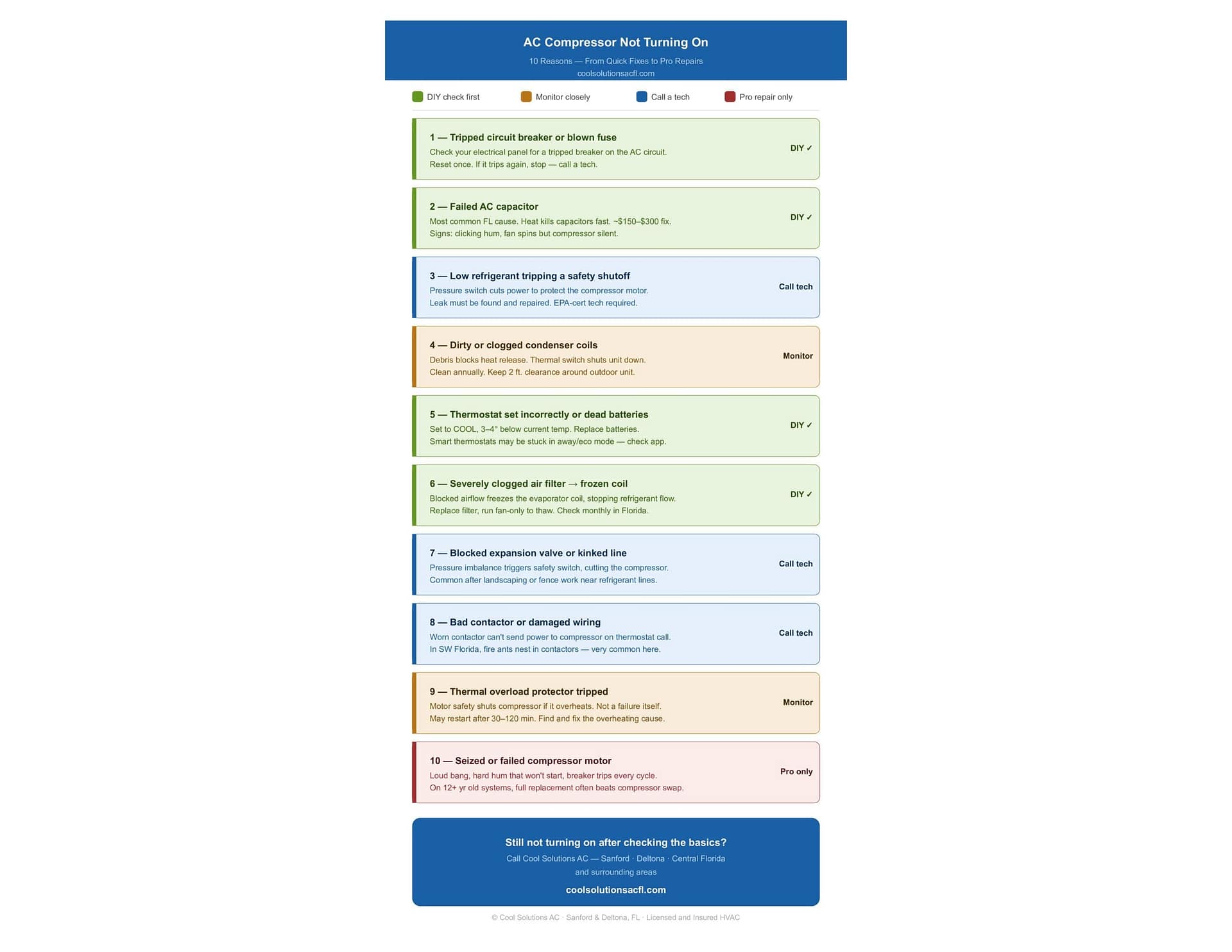
1. Tripped Circuit Breaker or Blown Fuse
This is always the first thing to check, and it’s one of the most common reasons the outdoor unit goes completely silent. Your air conditioner runs on a dedicated circuit, and that breaker can trip for several reasons — a power surge, a momentary voltage spike, or the system drawing too much current during a hot startup.
Head to your electrical panel and look for any breaker that’s flipped to the middle position or all the way to “off.” You’ll typically see one or two dedicated breakers labeled for the AC or air conditioner. Reset it by pushing it fully to “off” first, then flipping it back to “on.” If the breaker trips again almost immediately, don’t keep resetting it. A breaker that trips repeatedly is telling you there’s a deeper electrical issue — possibly a failing compressor drawing too much current, a short in the wiring, or a bad capacitor. Repeated resets without fixing the root cause can damage your system further or create a fire hazard.
Also check the disconnect box mounted on the exterior wall near your outdoor unit. This is a separate shutoff that technicians use when servicing the unit. Sometimes these get accidentally switched off, especially after yard work or landscaping. Pull it open and make sure the disconnect is firmly seated.
2. Failed AC Capacitor
If you had to pick the single most common cause of an AC compressor not turning on in Florida, the capacitor would win by a landslide. This small cylindrical component stores an electrical charge and delivers that burst of power needed to start the compressor motor. There’s usually a start capacitor that fires the compressor up, and a run capacitor that keeps it running smoothly during operation. Some units combine both functions into a single dual-run capacitor.
Capacitors are heat-sensitive, and Florida’s climate destroys them faster than almost anywhere else in the country. The combination of intense summer heat, high ambient temperatures inside the condenser cabinet, and continuous operation through a long cooling season significantly shortens capacitor lifespan. Most capacitors are rated to last 10 to 20 years under normal conditions, but in Southwest Florida, failing capacitors after five to eight years of heavy use are extremely common.
When a capacitor starts to fail, you may hear a clicking sound as the system tries to start but can’t quite get the compressor going. You might also notice the outdoor fan spinning while the compressor stays silent, or the system running but struggling, or making a humming sound without actually starting. A failed capacitor is one of the more affordable repairs — typically $150 to $300 for parts and labor — so it’s worth having a technician check this before assuming the compressor itself is bad.
3. Low Refrigerant Triggering a Safety Shutoff
Your AC system has low-pressure safety switches specifically designed to protect the compressor from running when refrigerant levels drop too low. If refrigerant leaks out — whether slowly over months or all at once due to a line damage — pressure in the system drops. When that pressure falls below a safe threshold, the low-pressure switch cuts power to the compressor automatically to prevent the motor from overheating and seizing without proper lubrication.
This is a really important point: the compressor not turning on due to a low-pressure lockout is actually the system working correctly. It’s trying to protect itself. The problem isn’t really the compressor — it’s the refrigerant leak that needs to be found and repaired.
Signs that point toward a refrigerant issue include: the system ran fine and then gradually got less effective over weeks or months before stopping, ice forming on the refrigerant lines or evaporator coil, a hissing or bubbling sound near the outdoor unit, or the system short-cycling (turning on and off repeatedly in short intervals). Refrigerant work requires EPA 608 certification — it’s not a DIY repair. A licensed technician will locate the leak, repair it, and recharge the system to the correct pressure.
4. Dirty or Clogged Condenser Coils
The condenser coils that wrap around the outside of your outdoor unit need to dissipate heat efficiently. When those coils get packed with dirt, grass clippings, cottonwood fluff, or the kind of fine debris that accumulates here in Florida, the unit can’t release heat properly. This causes the system to overheat, and built-in thermal protection switches will shut the compressor down to prevent permanent damage.
In South Florida, we also see compressor shutdowns caused by vines or vegetation growing into the unit, landscaping installed too close to the condenser (the unit needs at least two feet of clearance on all sides), and outdoor debris from hurricanes or tropical storms clogging the coil fins. Cleaning condenser coils is part of a proper AC tune-up and should be done at least once a year, ideally in the spring before the heavy cooling season starts.
5. Thermostat Problems
It sounds almost too simple, but thermostat issues are behind more service calls than you’d think. Before assuming the worst, confirm that your thermostat is actually set to “cool” mode — not just “fan” or “heat.” Make sure the set temperature is at least three to four degrees below the current indoor temperature so the system has a reason to kick on. Check the batteries if your thermostat is battery-powered, since a low battery can cause erratic behavior or complete failure to send the signal to start the compressor.
If you have a smart or programmable thermostat, check whether a scheduled mode change or an update to the device’s software has changed a setting unexpectedly. We’ve seen smart thermostats get stuck in “away” mode or “eco” mode, effectively preventing the system from cooling normally. A misconfigured thermostat can mimic a much more serious mechanical problem, so it’s always worth ruling this out first.
6. Dirty or Clogged Air Filter
A severely restricted air filter creates the same effect as closing most of your vents — airflow across the evaporator coil drops dramatically, the coil gets too cold and freezes over, and then the system shuts down on a safety. While a clogged filter more commonly causes the indoor coil to ice up rather than directly stopping the compressor, a frozen evaporator coil will absolutely prevent the system from cooling and can eventually cause the compressor to overheat due to the lack of refrigerant flow returning to it.
Check your filter. If it looks like a gray blanket, it needs to be replaced. In Florida homes with pets, dust, or higher than average foot traffic, filters can clog in as little as 30 days. Standard 1-inch filters in heavy-use situations should be checked monthly. If you find a completely frozen evaporator coil, turn the system off and run the fan only for a few hours to let it thaw before restarting.
7. Refrigerant Line Issues or Blocked Metering Device
Sometimes the compressor itself is perfectly fine but a blocked expansion valve or metering device prevents refrigerant from flowing properly. This can cause pressure imbalances that trigger safety switches, shutting down the compressor even though it’s mechanically sound. Similarly, a kinked or damaged refrigerant line — which can happen after landscaping work, fence installation, or any project that disturbs the lines running between your indoor and outdoor units — can restrict flow and cause the system to shut off on a pressure safety.
8. Electrical Wiring Issues or Contactor Problems
The contactor is an electrical switch inside your outdoor unit that controls power to the compressor and condenser fan motor. When your thermostat calls for cooling, it sends a low-voltage signal that triggers the contactor to close and send power to the compressor. Contactors can wear out, get pitted from electrical arcing over time, or fail outright.
In Florida, insects — particularly fire ants — are notorious for nesting inside electrical components and contactors. The ants are attracted to the electromagnetic field generated by the contactor, and their presence can cause shorts and failures. If you’re opening the disconnect box or access panel on your outdoor unit, check for ant activity. This is a surprisingly common cause of compressor no-starts in Southwest Florida.
Wiring issues can also develop over time as heat and vibration cause connections to loosen, or as UV exposure and salt air degrade wire insulation. A visual inspection of accessible wiring for burnt insulation, corrosion, or loose connections can sometimes reveal the problem.
9. Overheated Compressor Motor with Thermal Overload
Your compressor motor has a built-in thermal overload protector that shuts it down if the motor temperature gets dangerously high. This is a safety feature, not a failure — but it can make it look like the compressor has completely stopped working. Causes include running the system with low refrigerant, blocked airflow from dirty coils, extremely high ambient temperatures, or a compressor that’s working harder than it should due to another underlying problem.
When this happens, the compressor will often restart on its own after it cools down — usually anywhere from 30 minutes to a few hours. If your compressor seems to work for a while and then stops, then works again later, thermal overload is a likely culprit. The fix is addressing whatever is causing the overheating — not just waiting for it to cool and restart.
10. A Failing or Seized Compressor Motor
This is the scenario everyone dreads, and honestly it’s less common than the other causes on this list — but it does happen, especially in systems that are 12 to 15 years or older. A compressor can fail due to a seized motor (usually caused by running low on refrigerant for extended periods), burnt windings from electrical issues, or simple mechanical wear after years of operation.
Signs of a failed compressor include a loud banging or clanking noise from the outdoor unit, the compressor making a loud hum but never actually starting (a hard start), or the unit tripping the breaker every time it tries to run. If the compressor is truly failed on a unit that’s more than 10 to 12 years old, the more cost-effective decision is often full system replacement rather than a compressor-only swap. A new compressor on an old system doesn’t replace aging coils, old refrigerant lines, or a worn condenser fan motor.
What You Can Safely Check Yourself Before Calling
There are a handful of things you can do right now that might resolve the problem or at least give a technician useful information before they arrive. First, reset the circuit breaker once — flip it fully off, wait 30 seconds, then flip it back on. Second, check and replace your air filter if it’s visibly dirty. Third, confirm your thermostat settings are correct and replace the batteries. Fourth, go outside and look at the outdoor unit — check for visible debris blocking the coils, confirm there’s clearance around the unit, and see whether the condenser fan is spinning. Fifth, give the system about 30 minutes after a breaker reset before expecting it to start, since the compressor has its own internal reset that can take time.
Do not try to open the electrical panels on the outdoor unit yourself. Capacitors store a lethal electrical charge even when the unit is off, and working inside that cabinet without proper training and discharge tools is genuinely dangerous.
When to Call Cool Solutions AC in Sanford, Florida
If your AC compressor is still not turning on after checking the basics above, it’s time to call a licensed HVAC technician. The diagnostic equipment needed to properly test capacitors, check refrigerant pressure, test contactors, and evaluate compressor health is not the kind of thing homeowners have sitting in their garage. More importantly, refrigerant handling requires EPA certification — handling refrigerant without it is illegal.
At Cool Solutions AC, we serve Sanford, Deltona, Deland, Debary, New Smyrna, Daytona Beach, Daytona, Orange City, Lake Mary and Central Florida. Our technicians are trained to diagnose compressor no-start conditions quickly and accurately, so you’re not paying for guesswork. We’ll tell you exactly what’s wrong, what it will cost to fix it, and whether repair or replacement makes more sense given the age and condition of your system.
Florida’s heat is not forgiving. When your compressor stops working in July, you’re not just uncomfortable — prolonged indoor heat can be a genuine health risk, especially for elderly residents, young children, and pets. Don’t wait it out hoping the problem fixes itself. Most of the time it won’t, and running a system with an underlying problem can turn a $200 repair into a $2,000 one.
AC Compressor Not Turning On — Frequently Asked Questions
Why is my outside AC unit not turning on but the inside is?
This typically means the indoor air handler is receiving a signal from the thermostat and the blower motor is running, but the outdoor condensing unit — where the compressor lives — isn’t getting power or isn’t responding. Common causes are a tripped breaker for the outdoor circuit, a failed capacitor, a bad contactor, or a low-pressure safety shutoff due to low refrigerant. Start with the circuit breaker and thermostat settings, then call a technician if those check out normal.
Can a dirty filter cause the AC compressor to stop working?
Indirectly, yes. A severely clogged filter reduces airflow to the evaporator coil, which can cause the coil to freeze. A frozen coil blocks refrigerant flow back to the compressor and can eventually cause it to overheat and shut off on thermal protection. Replacing the filter and letting the coil thaw often restores normal operation, assuming no other damage occurred.
How do I know if my AC capacitor is bad?
Common signs include the outdoor unit making a clicking or humming sound but not fully starting, the fan spinning while the compressor stays silent, or the system running but not cooling efficiently. A swollen or leaking capacitor is visually obvious when you can see it — it will look bulged on top rather than flat. A technician can test capacitor microfarad values with a multimeter to confirm failure even when it looks normal externally.
My AC compressor makes a humming noise but won’t start — what does that mean?
A compressor that hums without starting is usually fighting through a failed capacitor or is mechanically seized. The motor is trying to turn over but can’t get the torque it needs. If it’s a capacitor issue, replacing it typically resolves the problem. If the motor itself is seized, that’s a more serious and expensive repair. Don’t let a system sit and hum for extended periods — it can burn out the motor windings if allowed to continue.
How long does an AC compressor last in Florida?
In Florida, most AC compressors last between 10 and 15 years with regular maintenance. The combination of year-round heavy use, high heat and humidity, and salt air in coastal areas like Sanford, Florida accelerates wear. Systems that receive annual tune-ups, have clean coils and filters, and are kept properly charged with refrigerant consistently last longer than neglected systems.
Is it worth repairing or replacing a failed AC compressor?
It depends heavily on the age of your system. If your unit is under 8 years old and otherwise in good condition, repairing or replacing the compressor can make economic sense. If the system is 12 or more years old, investing $1,500 to $3,000 in a new compressor for an aging system rarely makes sense — you’d be better served putting that money toward a new, more efficient system that comes with a warranty. A reputable HVAC technician will give you an honest assessment of both options.

William Todd Kirkpatrick is a licensed HVAC contractor in the state of Florida (License #CAC1815298) and the owner of Cool Solutions of Central Florida. Since 2007, Todd has helped homeowners stay comfortable with honest service, expert diagnostics, and a commitment to doing the job right the first time.